Kirsten Raymonde's memory loss
Station ElevenKirsten Raymonde’s memory loss is a defined blank rather than an erasure of her whole past: she cannot recall the thirteen months she spent on the road with her brother after they left Toronto. The year remains without a recoverable account, even as a scar and her brother’s nightmares mark its presence. Near the end of the novel, the gap acquires a painful echo in the Prophet, whose own lost childhood on the road may have left him with memories Kirsten cannot bear to retrieve.
The Missing Year
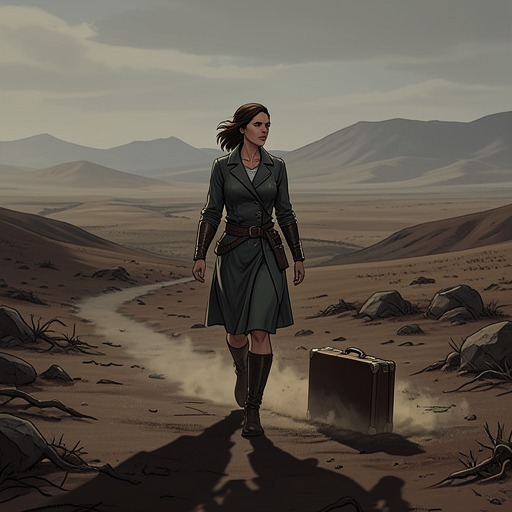
Kirsten’s lost time falls between leaving Toronto with her brother, Peter Raymonde, and arriving in an Ohio town where they stayed until his death. She later left that town with the Travelling Symphony. The boundary is clear; what happened during the intervening thirteen months is not. Kirsten can identify the period as the year she does not remember, but she cannot supply its events or explain its marks.
The memory gap is not presented as a mystery that receives a factual solution. When François Diallo asks how she got the scar on her face, Kirsten says she has no idea and locates its origin in the year she cannot remember. Peter never told her what had happened. He had instead said it was better if she did not remember, and Kirsten accepted his judgment. His silence gives the blank a second dimension: it is not only a failure of recollection but also something her brother chose not to explain.
Violence and the Decision Not to Remember
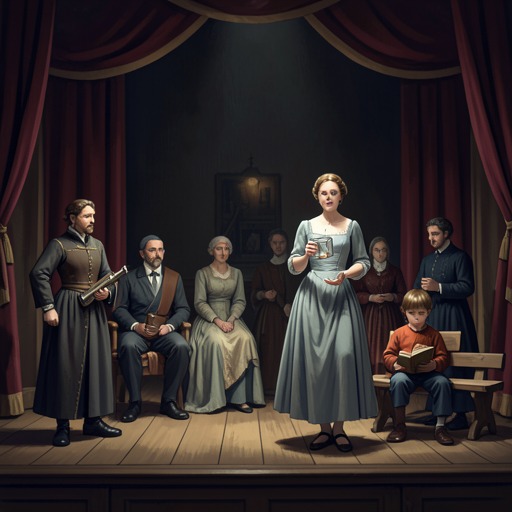
A separate episode, during Kirsten’s first year with the Travelling Symphony, gives her a reason to stop trying to retrieve the missing time. She was fifteen when a man rushed at her from the underbrush. Kirsten experienced the seconds as unnaturally stretched and soundless, drew a knife, and killed him with a throw to the throat. The Symphony gathered around her as ordinary time and sound returned. Dieter described the altered perception as a physiological response to danger, an explanation Kirsten found reasonable.
What troubled her was not the sensation itself but her calm afterward: she removed and cleaned the knife without the reaction she expected of herself. Kirsten could remember this encounter, but it did not unlock the earlier year. Instead, the contrast between the vivid violence she could recount and the unremembered road strengthened her resolve to stop searching. The novel keeps the two experiences distinct: the attack belongs to her first year with the troupe, while the scar belongs to the year before, whose events remain unknown.
Peter’s Warning and the Road
Peter’s nightmares are the only account the novel gives of what the missing year may have meant to him. After their first unremembered year, he was plagued by dreams. When Kirsten woke him and asked what he had been dreaming about, he answered, “The road,” and told her, “I hope you never remember it.” The brief exchange confirms his fear of her recollection without explaining its source. His warning may be protective, but the text does not disclose what he witnessed or what he believed Kirsten had experienced.
That silence shapes the memory loss as a shared wound with unequal access: Peter remembers enough to fear the road, while Kirsten is left with his words, her scar, and the boundary of the blank itself. His death closes off the possibility of asking him later. Kirsten’s acceptance of his advice is not proof that she has recovered or resolved the past; it is a decision to leave the unknowable year undisturbed.
The Prophet and the Unanswered Past
After the Prophet is killed, Kirsten kneels beside him and considers that he was about her age. He too had once been a boy adrift on the road; perhaps, she thinks, he had suffered the misfortune of remembering everything. This remains conjecture, not a revelation about either his memories or Kirsten’s lost year. The comparison nevertheless brings their different relationships to the past into focus: she has chosen not to pursue what is missing, while she imagines that his remembered history may have helped make him what he became.
Kirsten closes the Prophet’s eyes and places a folded page from Station Eleven in his hand. The gesture does not recover her own history or explain the Prophet’s. Instead, the ending leaves the road as an unanswered space shared by two people whose lives have been shaped by what can and cannot be remembered. The novel gives that absence concrete traces, but it does not turn them into a complete account.